Coil Primary Circuit Check
- Refer to step 1) of Control Module Feed Check for red wire circuit. If voltage was within 1.0 volt of battery voltage, turn ignition switch from "RUN" to "OFF". A spark should be seen each time ignition switch is turned "OFF". Then return ignition switch to "RUN" position. If modified plug sparks, proceed to Control Module & Stator Check. If no spark occurs, proceed to next step.
- Connect positive lead of voltmeter to ignition coil positive ("BAT") terminal and negative lead to ground. Reading should be 5-8 volts. If so, proceed to step 11). If less than 5 volts, proceed to step 10).
- If voltage in step 2) is battery voltage, disconnect 4-wire connector at control module. Insert a jumper wire (paper clip) into the 4-wire harness connector's terminals that mate with control module's green and black wires (terminals 1 and 8).
- Connect voltmeter positive lead to ignition coil positive ("BAT") terminal and negative lead to ground. Measure voltage. If battery voltage, proceed to step 6).
- If voltage now reads 4-7 volts, substitute (but do not install) a known good control module. And repeat previous tests. If spark occurs, reconnect original control module. If no spark now occurs, replace control module.
- If voltage in step 4) was battery voltage, make sure coil connector is fully engaged on primary terminals of ignition coil. Ground the "Tach Test" terminal of the coil. See Fig. 6.
Connect voltmeter positive lead to coil's positive ("BAT") terminal and negative lead to ground.
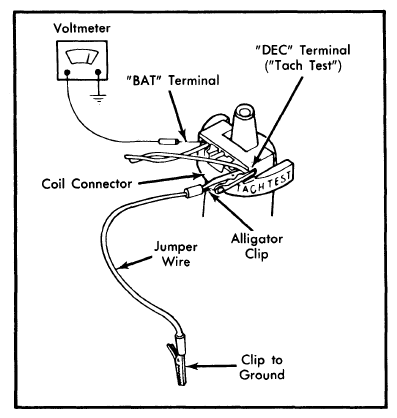 Courtesy of FORD MOTOR CO.
- If reading is now 4-7 volts, remove ground wire from "Tach Test" terminal of coil connector. Ground jumper wire (paper clip) in 4-wire connector. Again measure voltage at coil positive ("BAT") terminal. Reading should be approximately 4-7 volts. If so, proceed to step 9).
- If not, repair wire from control module to coil (mates with green wire, terminal 1). Remove jumper wire (paper clip) from 4-wire connector. Reconnect control module and retest system. If sparks occur at modified plug, system is OK.
- If voltage in step 7) was 4-7 volts, repair the ground circuit (black wire, terminal 8) from control module to distributor. Remove jumper wire (paper clip) from 4-wire connector and retest system. If sparks occur at modified plug, system is OK.
- If voltage in step 2) was less than 5 volts, repair wire feeding the ignition coil positive ("BAT") terminal. Retest system and if spark occurs at modified plug, system is OK.
- If voltage in step 2) was 5-8 volts, but engine would not run, or if voltage in step 6) was battery voltage, substitute (but do not install) a known good ignition coil and repeat system test. If sparks occur, reconnect original coil and retest. If no spark, replace ignition coil.
- If no sparks occurred with substitute coil, connect original ignition coil and be sure connector is fully engaged over terminals. Disconnect control module 4-wire connector and turn ignition switch to "RUN" position. Connect voltmeter positive lead to ignition coil connector's "Tach Test" terminal and negative lead to ground. See Fig. 6.
- If battery voltage exists, measure cranking voltage at positive coil terminal and recheck Control Module Feed Check on White Wire Circuit.
- If voltage in step 12) was zero volts, use an ohmmeter with ignition switch turned "OFF" and check for shorts in green wire circuit from control module to ignition coil. If additional wires are attached to negative ("Tach Test") terminal of ignition coil, check those circuits for shorts also. Repair wires as necessary.