Spark Check
- Using a high output spark tester, check for spark at coil wire while cranking engine. If spark is present, go to step 2). If spark is not present, remove distributor cap, and crank engine to check for distributor rotation. If distributor rotation is okay, check coil secondary wire resistance. Resistance should not be greater than 7000 ohms per foot.
- Place transmission in Neutral. Disconnect TFI wiring harness connector. Attach TFI Ignition Tester (105-000003). Connect Red lead of tester to 12 volts. Attach remote starter to "S" terminal of starter relay. While observing 2 LED lights on tester, use remote starter to crank engine. If PIP light blinks, go to step 4). If PIP light does not blink, remove distributor.
- Remove TFI module from distributor. Using an ohmmeter, ensure all circuit resistance values are correct. See TFI MODULE CIRCUIT RESISTANCE SPECIFICATIONS . See Fig 1. If readings are incorrect, replace TFI module. If readings are correct, check stator for open winding or short to ground. See I - SYS/COMP TESTS article in the ENGINE PERFORMANCE Section.
TFI MODULE CIRCUIT RESISTANCE SPECIFICATIONS
| TFI Terminals |
Ohms |
| Ground Pin - PIP |
More than 500 |
| Power Pin - PIP Input Pin |
Less than 2000 |
| Power Pin - TFI Power |
Less than 200 |
| Ground Pin - Ignition Ground |
Less than 2 |
| PIP Input Pin - PIP |
Less than 200 |
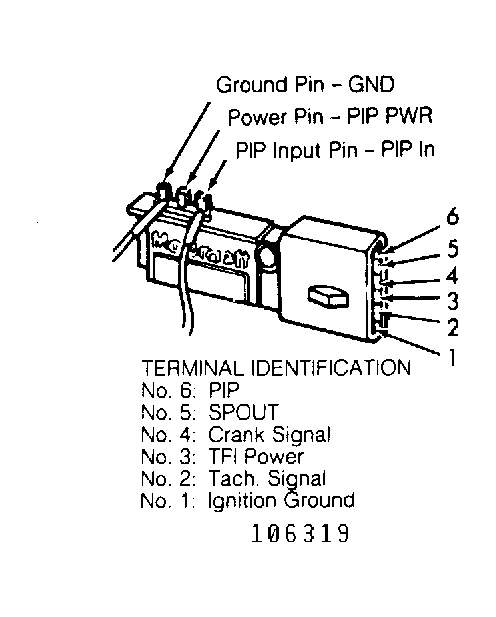 Courtesy of FORD MOTOR CO.
- If TACH light did not blink in step 2), replace TFI module, and repeat step 1). If spark is still not present, replace ignition coil and module connector. If TACH light did blink in step 2), substitute ignition coil with a known working unit, and repeat step 1). If spark is now present, ensure coil secondary wire resistance is not greater than 7000 ohms per foot, and replace ignition coil.
- If spark was not present in step 4), connect original vehicle coil and spark tester. Remove pin-in-line connector located near distributor. Crank engine while checking for spark. If spark is present, inspect PIP and ignition ground circuits to verify continuity, and repair as necessary.
- If spark was not present in step 5), measure battery voltage with negative lead from voltmeter attached to base of distributor. Measure voltage at ignition coil positive (+) terminal. Ignition coil positive (+) terminal voltage should be at least 90 percent of battery voltage. If not, check circuitry between ignition coil and ignition switch for wear or damage. Repair as necessary.
- If ignition coil positive (+) terminal voltage was at least 90 percent of battery voltage in step 6), remove connector from ignition module. Disconnect starter relay "S" terminal. Turn ignition on. Measure voltage at ignition module connector power terminals No. 3 and 4. See Fig 1. See TFI MODULE VOLTAGE TEST TERMINALS . Voltage should be at least 90 percent of battery voltage.
- If voltage is not at least 90 percent of battery voltage, check circuitry between ignition coil and ignition switch for wear or damage. Repair as necessary. If voltage was at least 90 percent of battery voltage in step 7), inspect wiring between ignition module terminal No. 2 and coil. If okay, check all related circuitry. Replace or repair as necessary.
TFI MODULE VOLTAGE TEST TERMINALS
| TFI Terminal |
Ignition Switch Position |
| With CCD |
| No. 3 |
Run & Start |
| Without CCD |
| No. 3 |
Run & Start |
| No. 4 |
Start |