All seats
- Install the manual lumbar assembly, if equipped.
Climate controlled seats
- Install the TED retainer clip.
- Install the climate controlled seat duct.
- Install the TED.
All seats
- Install the LH and RH inner shields and the 2 screws.
Seats with seat side air bags
WARNING:
Inspect the mounting surfaces of the side air bag module and the seat backrest frame mounting bracket for any foreign objects, before installing the side air bag module. If any foreign objects are found, remove them. Failure to do so may result in personal injury, in the event of an air bag deployment.
WARNING:
Inspect the side air bag deployment chute and the side air bag cavity in the seat backrest pad for any foreign objects. If any foreign objects are found remove them. Failure to do so may result in personal injury in the event of an air bag deployment.
WARNING:
Before installing the side air bag module, check it for damage and foreign objects. If the air bag module is damaged, replace it. If any foreign objects are found, remove them. Failure to do so may result in personal injury, in the event of an air bag deployment.
WARNING:
If the air bag cover has separated or the air bag material has been exposed, install a new side air bag module. Do not attempt to repair the air bag module. Failure to do so may result in personal injury, in the event of an air bag deployment.
WARNING:
Do not disconnect the wire connector at the seat side air bag module. This is a permanent connection. Doing so may result in accidental air bag deployment, which may result in personal injury.
NOTE:
The alignment pin will only allow the side air bag module to be installed to the seat backrest mounting bracket one way.
NOTE:
If installing a new seat side air bag module, use new retaining nuts. If the same seat side air bag module is to be reused then reuse the seat side air bag module nuts.
- Position the side air bag module onto the front seat backrest frame mounting bracket and install the nuts.
- Tighten to 10 Nm (89 lb-in).
- Route the side air bag module wire harness to the seat backrest frame.
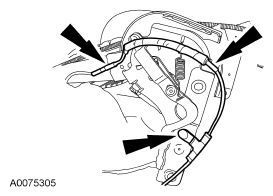 Courtesy of FORD MOTOR CO.
All seats
- If equipped and necessary, install a new backrest heater mat to the foam pad.
- Install the 2 hog rings from the lumbar-to-foam pad to the backrest foam pad.
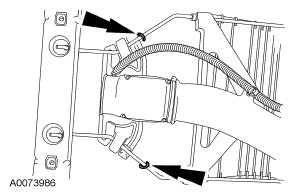 Courtesy of FORD MOTOR CO.
- With the backrest trim cover inverted, partially install the trim cover.
Seats with seat side air bags
WARNING:
Inspect the side air bag deployment chute and the side air bag cavity in the seat backrest pad for any foreign objects. If any foreign objects are found remove them. Failure to do so may result in personal injury, in the event of an air bag deployment.
WARNING:
Before installing the side air bag module into the deployment chute, check it for damage and foreign objects. If the air bag module is damaged, replace it. If any foreign objects are found, remove them. Failure to do so may result in personal injury, in the event of an air bag deployment.
WARNING:
Check the side air bag deployment chute and clips for damage. The deployment chute and clips must not be repaired. If there is any damage to the deployment chute or clips, the seat backrest trim cover and deployment chute must be installed new as a unit.
WARNING:
Check the side air bag deployment chute for damage. The deployment chute must not be repaired. If there is any damage to the deployment chute, the seat backrest trim cover and deployment chute must be installed new as a unit.
WARNING:
If the air bag deployment chute is not properly positioned, the side air bag may not deploy properly.
WARNING:
Inspect the mounting surfaces of the deployment chute and the seat backrest frame mounting bracket for any foreign objects, before installing the side air bag module/deployment chute assembly. If any foreign objects are found, remove them. Failure to do so may result in personal injury, in the event of an air bag deployment.
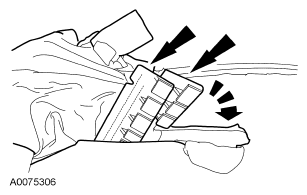 Courtesy of FORD MOTOR CO.
- Position the deployment chute and clips through the backrest foam pad.
WARNING:
If the air bag deployment chute is not properly positioned and completely closed, the side air bag may not deploy properly.
- Position the air bag deployment chute.
- Insert the outboard side of the air bag deployment chute between the seat backrest pad and the side air bag module pulling it around the outboard side of the seat backrest frame.
- Insert the inboard side of the air bag deployment chute between the seat backrest pad and the side air bag module from the inboard side of the seat backrest.
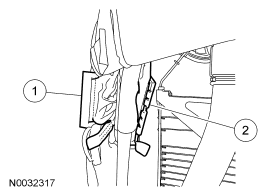 Courtesy of FORD MOTOR CO.
WARNING:
If the air bag deployment chute is not properly positioned and completely closed, the side air bag may not deploy properly.
- Attach the deployment chute clips and hook and loop strips.
- The side air bag deployment chute must encircle the side air bag module, going completely around the side air bag module and the side of the seat backrest frame.
- Align the side air bag deployment chute to the side air bag module, making sure it covers the length of the side air bag module, it must not cover the top or the bottom of the side air bag module.
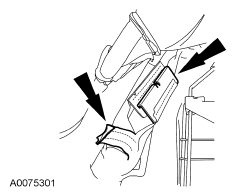 Courtesy of FORD MOTOR CO.
All seats
- Install the backrest trim cover and install new hog rings.
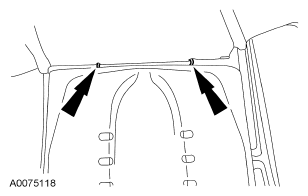 Courtesy of FORD MOTOR CO.
- Roll the seat backrest trim cover down and reattach the lower J-clips.
- Make sure any necessary wire harnesses, connectors or ducts are through the trim cover openings.
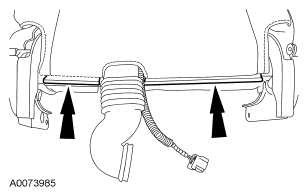 Courtesy of FORD MOTOR CO.
- Install the armrest stop screw to the backrest.
- Position the armrest to the backrest and install the bolt and spring washer.
- Tighten to 25 Nm (18 lb-ft).
- Install the armrest bolt cover.
- Install the head restraint sleeves.
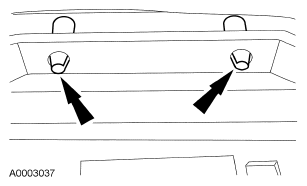 Courtesy of FORD MOTOR CO.
- Install the front seat backrest. For additional information, refer to SEAT BACKREST - FRONT in this article.
- Install the affected seat and repower the SRS. Do not prove out the SRS at this time.
For additional information, refer to SEAT - FRONT in this article.
Passenger seat
CAUTION:
There are 3 occupant classification sensor (OCS) system service kits available for this vehicle (base seat, heated seat and climate controlled seat). Always make sure the correct OCS service kit is installed.
CAUTION:
It is necessary to rezero the OCS system when a front passenger seat cushion is disassembled, a new trim cover installed, a seat side shield removed or an OCS service kit is installed. A diagnostic tool is used to trigger the active command to carry out rezeroing of the OCS system.
CAUTION:
Make sure the seat is completely assembled before rezeroing.
CAUTION:
The following precautions must be taken before rezeroing the OCS system:
- Make sure the OCS system components are connected and no faults are present.
- Make sure the OCS system is not at a temperature below 0°C (32°F) or above 45°C (113°F) when initiating the rezeroing process. If the vehicle has been exposed to extreme cold or hot temperatures, the vehicle must be exposed and kept at a temperature within the limits, 0°C to 45°C (32°F to 113°F) for a minimum of 30 minutes.
- Make sure nothing is present on the passenger seat before rezeroing and nothing is placed on the seat during the rezeroing process.
- Make sure a minimum 8 second time period has passed after cycling the ignition switch ON before the rezeroing process.
NOTE:
For best results in rezeroing, the OCS system should be at or near room temperature, 10°C to 29°C (50°F to 85°F).
NOTE:
The heater mat on the front passenger seat cushion is not serviceable separately. If a new heater mat is needed on the front passenger seat cushion a new occupant classification sensor (OCS) service kit, equipped with a heater mat, must be installed.
NOTE:
If the first attempt to rezero the OCS system is unsuccessful, a second attempt must be made.
- If the passenger seat backrest was removed, rezero the occupant classification sensor.
- With the front passenger seat empty, use a diagnostic tool to trigger the active command and rezero the occupant classification sensor.
NOTE:
The ignition switch must be cycled after rezeroing the OCS system.
- Cycle the ignition switch from ON to OFF.
All seats
- Prove out the supplemental restraint system (SRS) as follows:
Turn the ignition key from ON to OFF. Wait 10 seconds, then turn the key back to ON and visually monitor the air bag indicator with the air bag modules installed. The air bag indicator will light continuously for approximately 6 seconds and then turn off. If an air bag supplemental restraint system (SRS) fault is present, the air bag indicator will:
- Fail to light.
- Remain lit continuously.
- Flash.
The flashing might not occur until approximately 30 seconds after the ignition switch has been turned from the OFF to the ON position. This is the time required for the restraints control module (RCM) to complete the testing of the SRS. If the air bag indicator is inoperative and a SRS fault exists, a chime will sound in a pattern of 5 sets of 5 beeps. If this occurs, the air bag indicator and any SRS fault discovered must be diagnosed and repaired.
Clear all continuous DTCs from the restraints control module using a diagnostic tool.