Pinpoint Test
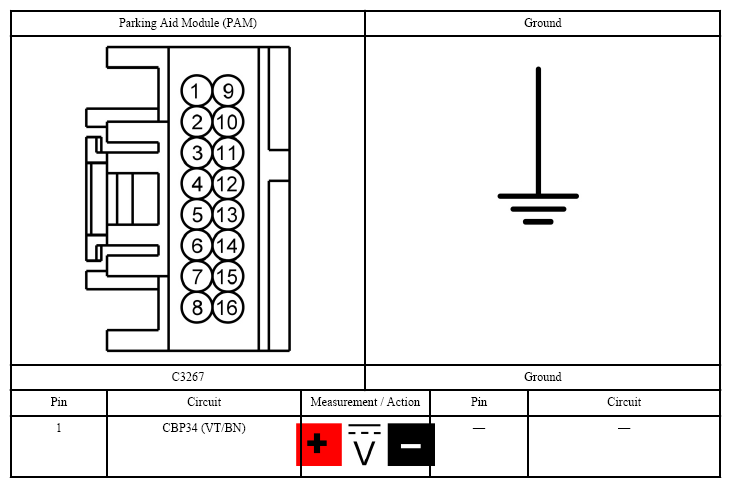
- CHECK THE Parking Aid Module (PAM) VOLTAGE SUPPLY CIRCUIT FOR AN OPEN
- Ignition OFF.
- Disconnect: Parking Aid Module (PAM).
- Ignition ON.
- Measure:
 Courtesy of FORD MOTOR CO.
- Is the voltage greater than 11 volts?
- Yes:
GO to 2
on page 2.
- No:
VERIFY the Body Control Module (BCM) fuse 34 (10A) is OK. If OK, REPAIR the circuit. If not OK, REFER to the SYSTEM WIRING DIAGRAMS
to identify the possible causes of the circuit short.
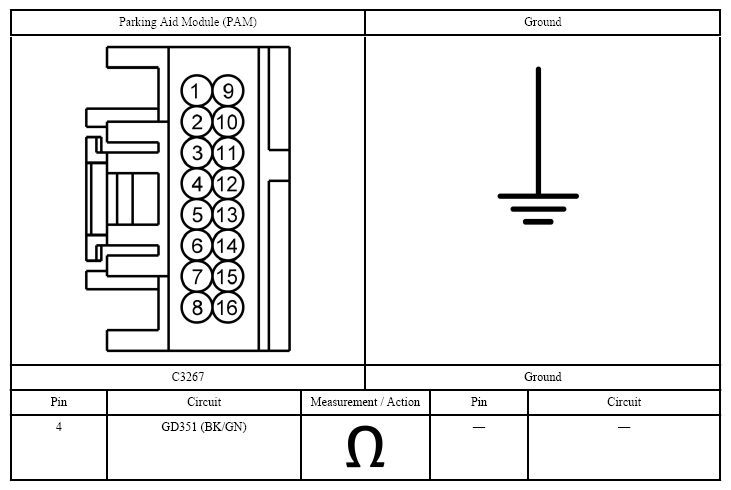
- CHECK THE Parking Aid Module (PAM) GROUND CIRCUIT FOR AN OPEN
- Ignition OFF.
- Measure:
 Courtesy of FORD MOTOR CO.
- Is the resistance less than 3 ohms?
- Yes:
GO to 3
on page 3.
- No:
REPAIR the circuit.
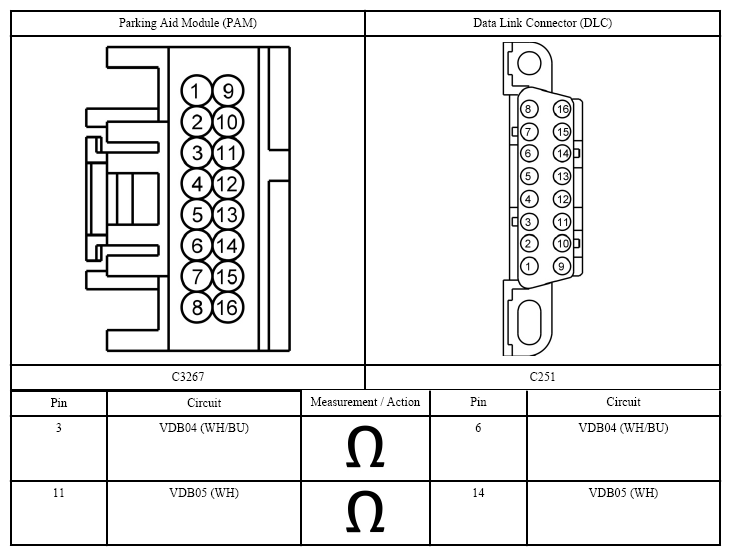
- CHECK THE High Speed Controller Area Network (HS-CAN) CIRCUITS BETWEEN THE Parking Aid Module (PAM) AND THE Data Link Connector (DLC) FOR AN OPEN
- Measure:
 Courtesy of FORD MOTOR CO.
- Are the resistances less than 3 ohms?
- Yes:
GO to 4
on page 4.
- No:
REPAIR the circuit in question.
- CHECK FOR CORRECT Parking Aid Module (PAM) OPERATION
- Ignition OFF.
- Disconnect and inspect the Parking Aid Module (PAM) connector.
- Repair:
- corrosion (replace connector or terminals - clean module pins)
- damaged or bent pins - replace terminals/pins
- pushed-out pins - replace pins as necessary
- Reconnect the Parking Aid Module (PAM) connector. Make sure it seats and latches correctly.
- Operate the system and verify the concern is still present.
- Is the concern still present?
- Yes:
CHECK On-Line Automotive Service Information System (OASIS) for any applicable Technical Service Bulletins (TSBs). If a Technical Service Bulletin (TSB) exists for this concern, discontinue this test and follow Technical Service Bulletin (TSB) instructions. If no Technical Service Bulletins (TSBs) address this concern, INSTALL a new Parking Aid Module (PAM). REFER to PARKING AID MODULE (PAM) .
- No:
The system is operating correctly at this time. Concern may have been caused by a loose or corroded connector.