Valve Clearance
- With engine cold, disconnect negative battery cable. Drain engine coolant. On automatic transmission models, disconnect throttle cable from throttle body and bracket. Disconnect accelerator cable and bracket from throttle body and air intake chamber.
- Disconnect airflow meter connector and air hoses. Loosen air cleaner hose clamp bolt. Release air cleaner cover clips and remove air cleaner cap and airflow meter together with air cleaner hoses.
- Remove the following hoses: PCV, water by-pass, vacuum sensing, fuel pressure VSV and emission control vacuum control hoses. Disconnect ISC, throttle position sensor and EGR gas temperature sensor connectors.
- Remove 3 bolts and right engine mounting stay. Disconnect cold start injector and tube. Disconnect brake booster vacuum and cruise control vacuum hoses. Remove ground strap connector. Remove nut and wire harness. Disconnect EGR pipe.
- Remove 2 bolts and engine hanger. Remove bolt and disconnect air intake chamber stay from air intake chamber. Remove 2 bolts, nuts, air intake chamber and gasket. Remove cylinder head covers.
- Rotate crankshaft pulley and align pulley groove with "0" mark on timing belt cover to position No. 1 cylinder at TDC of compression stroke. Ensure cylinder No. 1 intake valve lifters are loose and exhaust valve lifters are tight. If not, rotate crankshaft 360 degrees and realign timing marks.
- Measure and record clearance of intake valves on cylinders No. 1 and 6, and exhaust valves on cylinders No. 2 and 3. See Fig 1. Rotate crankshaft pulley 240 degrees (2/3 of a revolution). Measure and record clearance of intake valves on cylinders No. 2 and 3, and exhaust valves on cylinders No. 4 and 5.
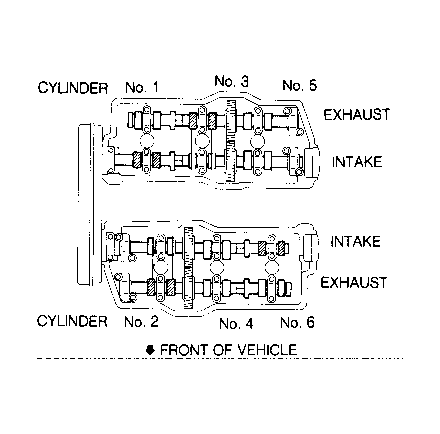 Courtesy of © TOYOTA, LICENSE AGREEMENT TMS1002
- Rotate crankshaft pulley another 240 degrees (2/3 of a revolution). Measure and record clearance of intake valves on cylinders No. 4 and 5, and exhaust valves on cylinders No. 1 and 6.
- Determine if clearance is within specification. See VALVE CLEARANCE SPECIFICATIONS TABLE. If clearance adjustment is required, rotate crankshaft pulley to position lobe upward on the valve to be adjusted.
- Use Valve Clearance Adjuster (SST 09248-55011) to press valve lifter downward. Prior to pressing lifter downward, position adjustment shim notch area toward the spark plug.
- Press valve lifter downward using SST (A) and install SST (B) between camshaft and valve lifter and remove SST (A). See Fig 2. Using a small screwdriver and magnet, remove adjustment shim.
 Courtesy of © TOYOTA, LICENSE AGREEMENT TMS1002
- Using a micrometer, measure thickness of shim just removed. Select a new shim that will give correct valve clearance. See VALVE CLEARANCE SPECIFICATIONS TABLE. Shims are available in thickness of .0984-.1299" (2.50-3.30 mm) in .002" (.05 mm) increments.
- Install proper shim. Using SST (A), press downward on valve lifter and remove SST (B). Recheck valve clearance. Install air intake chamber using new gaskets. Tighten air intake chamber bolts to 32 ft. lbs. (43 N.m) and EGR pipe to 58 ft. lbs. (78 N.m). Install remaining components.
- Air must be bled from cooling system while filling cooling system. To bleed air from cooling system, open union bolt (bolt closest to upper radiator hose on radiator hose outlet on intake manifold) approximately 5 revolutions. Fill cooling system and tighten union bolt to 13 ft. lbs. (18 N.m).
VALVE CLEARANCE SPECIFICATIONS
| Application |
In. (mm) |
| Exhaust |
.011-.015 (.27-.37) |
| Intake |
.005-.009 (.13-.23) |