EGR System
- Remove filters from EGR vacuum modulator. See Fig 1. Using compressed air, clean filters. Install filters with coarse side facing outward.
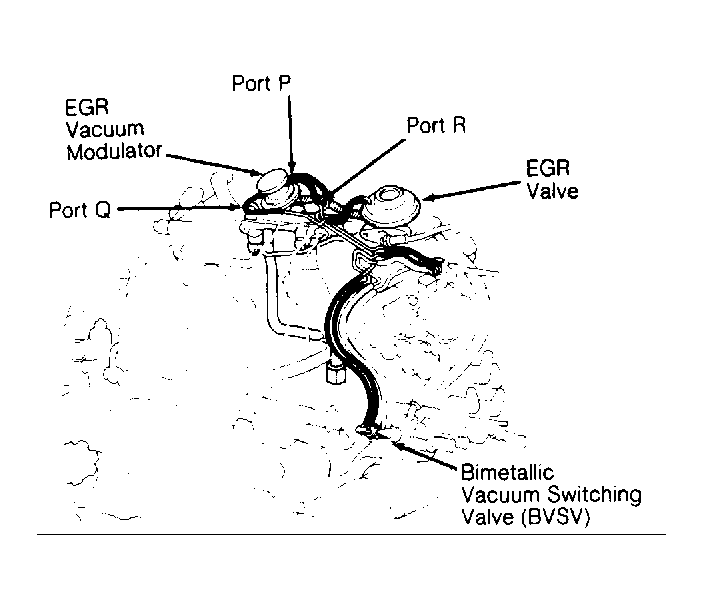 Courtesy of © TOYOTA, LICENSE AGREEMENT TMS1002
- Using a vacuum "T", connect a vacuum gauge between EGR vacuum hose and EGR valve (between EGR vacuum hose and vacuum switching valve on LS400). To ensure EGR valve is seating, start engine and check idle quality. If EGR valve is not seating, replace EGR valve.
- With coolant temperature less than 104°F (40°C) on ES250 or 127°F (53°C) on LS400, vacuum gauge should indicate zero vacuum at 2500 RPM. Warm engine to operating temperature. Raise engine speed to 2500 RPM. Vacuum gauge should indicate approximately 2.76 in. Hg.
- Disconnect vacuum hose from port "R" of EGR vacuum modulator (lower of two ports on side of modulator). See Fig 1. Connect port "R" directly to intake manifold using another vacuum hose. Vacuum gauge should indicate high vacuum with engine at 3500 RPM on ES250 or 2500 RPM on LS400.
- Engine may misfire slightly. Let engine idle. Remove vacuum gauge, and reconnect all vacuum hoses. Disconnect vacuum hose from EGR valve. Apply vacuum directly to EGR valve. Engine should run rough or stall. If results are as indicated, system is okay.