Rear Light Failure Sensor
- If rear light failure warning light is not operating correctly, disconnect harness connector from rear light failure sensor located in trunk, and ground terminal No. 4. See Fig 1. Turn ignition on and ensure warning light glows. Start engine and ensure warning light goes out. If operation is not as specified, check bulb. If bulb is okay, go to next step.
- Using a DVOM, check for continuity between ground and terminals No. 1, 2, 6, 7, 11 and 12. See Fig 1. Continuity should exist on all terminals. Terminals No. 1, 2, 6, 7 and 12 will read slight resistance as they are grounded through bulbs. If continuity is as specified, go to next step. If continuity is not as specified, repair wiring.
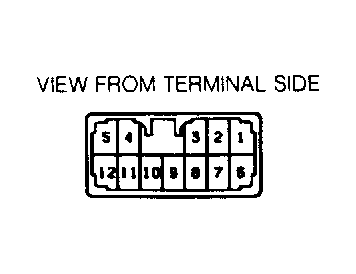 Courtesy of © TOYOTA, LICENSE AGREEMENT TMS1002
- Check for voltage between terminal No. 5 and ground. With headlights off, no voltage should be present. Turn headlights on. If battery voltage is present, go to next step. If battery voltage is not present, check headlight switch and wiring.
- Check for voltage between terminal No. 4 and ground. With engine off, no voltage should be present. Start engine. If battery voltage is present, go to next step. If battery voltage is not present, check wiring between instrument panel and rear light failure sensor.
- Check for voltage between ground and terminals No. 9 and 10. With brake pedal released, no voltage should be present. Depress brake pedal. If battery voltage is present, go to next step. If battery voltage is not present, check brake switch and wiring.
- Check for voltage between terminal No. 8 and ground. With ignition switch in LOCK or ACC position, no voltage should be present. Turn ignition on. If battery voltage is not present, check ignition switch and wiring. If battery voltage is present, test is complete. Substitute known good rear light failure sensor and recheck warning light operation.