Diagnosis & Repair (Using Lexus Scan Tester)
- Connect Lexus scan tester to Data Link Connector (DLC) No. 3. Turn ignition and scan tester on. Using scan tester, select ACTIVE TEST mode. Check operation of VSV when activated by scan tester. VSV is located under engine cover.
- With purge control VSV on, air from pipe "E" should exhaust out pipe "F". See Fig 1. With purge control VSV off, air should not exhaust out pipe "F". If VSV operates as specified, go to step 5). If VSV does not operate as specified, go to next step.
- Remove purge control VSV. Using ohmmeter, measure resistance between VSV terminals. With VSV temperature at 68°F (20°C), resistance should be 30-34 ohms. Measure resistance between each terminal and body of valve. Resistance should be infinite. If resistance is as specified, go to next step. If resistance is not as specified, replace VSV.
- Using jumper wires, apply battery voltage to VSV terminals. Air from pipe "E" should exhaust out pipe "F". See Fig 1. Disconnect jumper wires. Air should not exhaust out pipe "F". If VSV does not operate as specified, replace VSV. If VSV operates as specified, check for open or short circuit in wiring harness between EFI main relay and ECM. See appropriate wiring diagram in appropriate WIRING DIAGRAMS
article. Repair as necessary. If wiring is okay, replace ECM and retest.
- Check VSV vacuum hose connections. Repair as necessary. If hose connections are okay, check charcoal canister. See EMISSION SYSTEMS & SUB-SYSTEMS in SYSTEM/COMPONENT TESTS
article. Replace as necessary.
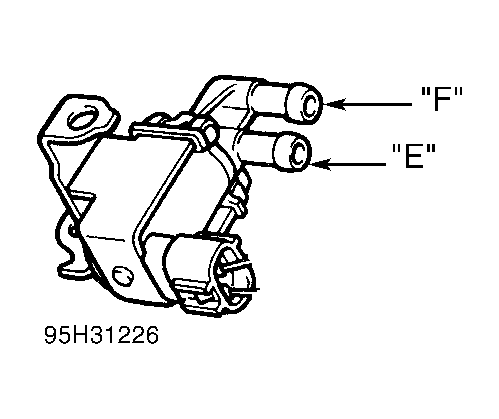 Courtesy of © TOYOTA, LICENSE AGREEMENT TMS1002