Electronic Throttle Control (ETC) System Strategy
The torque based ETC strategy was developed to improve fuel economy and to accommodate variable camshaft timing (VCT). This is possible by not coupling the throttle angle to the driver pedal position. Uncoupling the throttle angle (produce engine torque) from the pedal position (driver demand) allows the powertrain control strategy to optimize fuel control and transmission shift schedules while delivering the requested wheel torque.
The ETC monitor system is distributed across 2 processors within the PCM: the main powertrain control processor unit (CPU) and a monitoring processor called an enhanced-quizzer (E-Quizzer) processor. The primary monitoring function is carried out by the independent plausibility check (IPC) software, which resides on the main processor. It is responsible for determining the driver-demanded torque and comparing it to an estimate of the actual torque delivered. If the generated torque exceeds driver demand by a specified amount, the IPC takes appropriate corrective action.
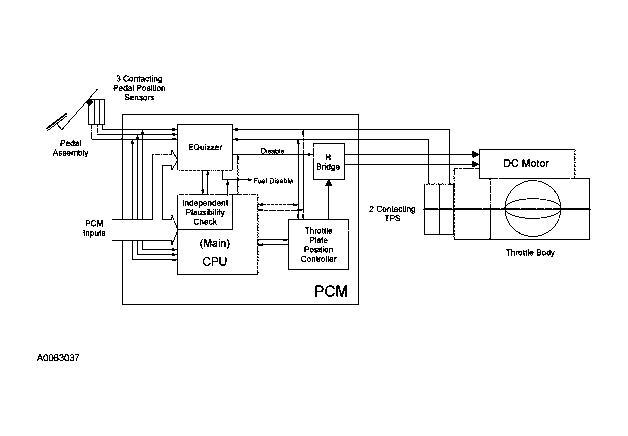 Courtesy of FORD MOTOR CO.
Since the IPC and the main controller share the same processor, they are subject to a number of potential common failure modes. The E-Quizzer processor was added to redundantly monitor selected PCM inputs and to act as an intelligent watchdog and monitor the performance of the IPC and the main processor. If it determines that the IPC function is impaired in any way, it takes appropriate failure mode and effects management (FMEM) actions.
ETC SYSTEM FAILURE MODE AND EFFECTS MANAGEMENT:
| Effect |
Failure Mode |
| No Effect on Driveability |
A loss of redundancy or loss of a non-critical input could result in a concern that does not affect driveability. The powertrain malfunction indicator (wrench) illuminates, but the throttle control and torque control systems function normally. |
| Disable Speed Control |
If certain concerns are detected, speed control is disabled. Throttle control and torque control continue to function normally. |
| RPM Guard with Pedal Follower |
In this mode, torque control is disabled due to the loss of a critical sensor or PCM concern. The throttle is controlled in pedal-follower mode as a function of the pedal position sensor input only. A maximum allowed RPM is determined based on pedal position (RPM Guard). If the actual RPM exceeds this limit, spark and fuel are used to bring the RPM below the limit. The powertrain malfunction indicator (wrench) and the MIL illuminate in this mode and a DTC P2106 or a DTC for an ETC-related component is set. EGR, VCT, and IMRC outputs are set to default values. |
| RPM Guard with Default Throttle |
In this mode, the throttle plate control is disabled due to the loss of throttle position, the throttle plate position controller, or other major electronic throttle body concern. A default command is sent to the TPPC, or the H-bridge is disabled. Depending on the concern detected, the throttle plate is controlled or springs to the default (limp home) position. A maximum allowed RPM is determined based on pedal position (RPM Guard). If the actual RPM exceeds this limit, spark and fuel are used to bring the RPM below the limit. The powertrain malfunction indicator (wrench) and the MIL illuminate in this mode and a DTC P2110 is set. EGR, VCT, and IMRC outputs are set to default values. |
| RPM Guard with High Forced Idle |
This mode is caused by the loss of 2 or 3 pedal position sensor inputs due to sensor, wiring, or PCM concerns. The system is unable to determine driver demand, and the throttle is controlled to a fixed high idle airflow. There is no response to the driver input. The maximum allowed RPM is a fixed value (RPM Guard). If the actual RPM exceeds this limit, spark and fuel are used to bring the RPM below the limit. The powertrain malfunction indicator (wrench) and the MIL illuminate in this mode and a DTC P2104 is set. EGR, VCT, and IMRC outputs are set to default values. |
| Shutdown |
If a significant processor concern is detected, the monitor forces vehicle shutdown by disabling all fuel injectors. The powertrain malfunction indicator (wrench) illuminates in this mode and a DTC P2105 is set. |
ELECTRONIC THROTTLE MONITOR OPERATION:
| DTCs |
|
| P0606, P060X, P061X |
PCM processor concern (MIL, powertrain malfunction indicator [wrench]) |
| P2104 |
ETC FMEM - forced idle, 2 or 3 pedal sensor concerns (MIL, powertrain malfunction indicator [wrench]) |
| P2105 |
ETC FMEM - forced engine shutdown; E-Quizzer detected concern (MIL, powertrain malfunction indicator [wrench]) |
| P2106 |
ETC FMEM - forced limited power; sensor concern: MAF, one TP, CKP, TSS, OSS, stuck throttle, throttle actuator circuit concern (MIL, powertrain malfunction indicator [wrench]) |
| P2110 |
ETC FMEM - forced limited RPM; Concern with 2 TPs; TPPC detected concern (MIL, powertrain malfunction indicator [wrench]) |
| U0300 |
ETC software version mismatch, IPC, E-Quizzer or TPPC (non-MIL, powertrain malfunction indicator [wrench]) |