- HC1 DTC P0148 OR SYMPTOMS WITHOUT DTCS: CHECK THE SYSTEM INTEGRITY
- Visually inspect the complete fuel delivery system for damage and leakage.
- Check the following:
- fuel lines and connections
- relays
- fuel tank
- fuel pump
- fuel pressure regulator
- fuel pulse damper
- fuel rail at injectors
- damaged connector pins
- electrical connectors not fully engaged
- Verify the vehicle has followed the maintenance schedule. A new fuel filter should have been installed within the last 48,280 km (30,000 miles).
- Verify the inertia fuel shutoff (IFS) switch is set (button pushed in). Refer to the Owner's Literature for location.
- Verify the fuse integrity.
- Verify the battery is fully charged.
- Verify clean sufficient fuel.
- Is a concern present?
| Yes |
No |
REPAIR as necessary.
CLEAR the DTCs. REPEAT the self-test. |
GO to HC2. |
- HC2 CHECK ALL SYSTEM RELATED DEVICES (SENSOR, DAMPER OR REGULATOR) FOR LEAKAGE
- Key in OFF position.
- FP connector connected.
- Remove the vacuum hose on each system device connected to the fuel rail.
- Inspect for the presence of fuel in the vacuum line of each device connected to the fuel rail.
- Key ON, engine running.
- Check for manifold vacuum at each system related component with a vacuum line.
- Key in OFF position.
- Are all vacuum lines for system related devices indicating no fuel present?
| Yes |
No |
| GO to HC3. |
If the vacuum line connected to a component indicates that a fuel leak is present, INSTALL a new component.
CLEAR the DTCs. REPEAT the self-test. |
- HC3 CHECK THE FUEL PRESSURE
- Key in OFF position.
- Relieve the fuel pressure. Refer to the appropriate FUEL SYSTEM - GENERAL INFORMATION
article for the Fuel System Pressure Release procedure.
- Mechanical fuel pressure gauge connected.
- Key ON, engine OFF.
- Pressurize the fuel system. Refer to the appropriate FUEL SYSTEM - GENERAL INFORMATION
article for the Fuel System Pressure Release procedure to pressurize the fuel system.
- FP connector connected.
- Cycle the key several times to charge the fuel system.
- Compare the fuel pressure reading to the Fuel System Specification Chart.
- Is the fuel pressure within range?
| Yes |
No |
| GO to HC6. |
GO to HC4. |
- HC4 CHECK THE FUEL PUMP GROUND CIRCUIT FOR AN OPEN IN THE HARNESS
NOTE:
Refer to the appropriate SYSTEM WIRING DIAGRAMS
article for schematic and connector information.
- FP connector disconnected.
- Measure the voltage between:
| ( + ) Vehicle Battery |
( - ) FP Connector, Harness Side |
| Positive terminal |
FPGND |
- Is the voltage greater than 10 V?
| Yes |
No |
| GO to HC5. |
REPAIR the open circuit. CLEAR the DTCs. REPEAT the self-test. |
- HC5 CHECK THE FUEL PUMP POWER CIRCUIT FOR AN OPEN IN THE HARNESS
NOTE:
During output state control, the fuel pump stays commanded on for only about 5 seconds.
- Verify the inertia fuel shutoff (IFS) switch is set (button pushed in). Refer to the Owner's Literature for location.
- FP connector disconnected.
- Key ON, engine OFF.
- Access the PCM and control the FP PID.
- Be aware that output state control turns off the FP after a calibrated time. If this happens, command the outputs on again to continue testing.
- Measure the voltage between:
| ( + ) FP Connector, Harness Side |
( - ) Vehicle Battery |
| FPPWR |
Negative terminal |
- Is the voltage greater than 10 V?
| Yes |
No |
| GO to HC12. |
REPAIR the open circuit. CLEAR the DTCs. REPEAT the self-test. |
- HC6 CHECK THE SEPARATION LEVEL OF THE ETHANOL/WATER MIXTURE AND GASOLINE IN THE FUEL
NOTE:
This step requires the use of a locally obtained 200 ml beaker and a 25 ml graduated cylinder.
NOTE:
After approximately 3 minutes of standing, the ethanol and water mixes together and settles to the bottom of the 25 ml graduated cylinder. The gasoline rises to the top.
- Fill the 200 ml beaker with 5 ml of clean water.
- Use the pressure relief valve on the mechanical fuel gauge to drain 22 ml of fuel into an approved clean container.
- Pour 20 ml of fuel from the approved clean container into the 25 ml graduated cylinder.
- Add enough water from the 200 ml beaker to the 25 ml graduated cylinder to bring the total volume of liquid to 24 ml.
- Insert a stopper plug in the opening of the 25 ml graduated cylinder.
- Firmly hold the stopper in place and shake the 25 ml graduated cylinder to mix the water and fuel.
- Allow the liquid to stand and separate for approximately 3 minutes.
- Record the separation level from the 25 ml graduated cylinder where the ethanol/water mixture and gasoline meet.
- Did the ethanol/water mixture and gasoline separate?
| Yes |
No |
| GO to HC7. |
COMPLETE all steps before continuing. The ethanol/water mixture will separate from the gasoline. If the fuel does not appear to separate, then the fuel is either 100% ethanol or a mixture of ethanol and water. |
- HC7 CALCULATE THE PERCENTAGE OF ETHANOL IN THE FUEL
NOTE:
Use the illustration as an example for calculating the percentage of ethanol in the following steps. If the separation level is at 14 ml the calculation becomes; 14 minus 4, then multiply by 5 to equal 50. The percentage of ethanol in the fuel is 50%.
- Key in OFF position.
- Take the recorded separation level from the previous step and subtract the amount of water added.
- Multiply the new value by 5. This new value is the percentage of ethanol in the fuel.
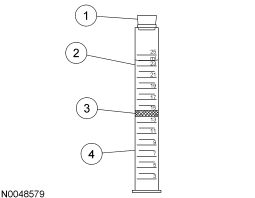 Courtesy of FORD MOTOR CO.
| Item Number |
Description |
| 1 |
Stopper |
| 2 |
Gasoline |
| 3 |
Separation Point at 14 ml |
| 4 |
Ethanol/Water Mixture |
- Record the calculated percentage of ethanol in the fuel.
- Is any ethanol present in the fuel?
| Yes |
No |
For flex fuel vehicles, GO to HC8.
For all others, GO to HC11. |
GO to HC12. |
- HC8 COMPARE THE FF_INF PID TO THE CALCULATED PERCENTAGE OF ETHANOL
NOTE:
When determining if the FF_INF PID value is within 50% of the calculated percentage of ethanol, if the calculated percentage of ethanol value is 40% then the PID value should be between 0 - 90%. The PID value cannot be less than zero.
- Key ON, engine OFF.
- Access the PCM and monitor the FF_INF PID.
- Compare the FF_INF PID to the calculated percentage of ethanol.
- Is the FF_INF PID value within 50% of the calculated percentage of ethanol?
| Yes |
No |
| GO to HC12. |
GO to HC9. |
- HC9 RESET THE PERCENT ETHANOL PARAMETER IN THE PCM
NOTE:
Certain customer fueling practices such as only fueling with small amounts of fuel or repeatedly switching between gasoline and an ethanol blend greater than E15 may prevent the PCM from learning the correct ethanol content in the fuel.
- Reset the keep alive memory (KAM). Refer to RESETTING THE KEEP ALIVE MEMORY (KAM)
.
- Key ON, engine running.
- Access the PCM and monitor the FF_LRND PID.
- Drive the vehicle approximately 11.3 km (7 miles) or until the FF_LRND PID indicates yes.
- Is the PID state YES?
| Yes |
No |
| GO to HC10. |
GO to HC18. |
- HC10 COMPARE THE UPDATED FF_INF PID TO THE CALCULATED PERCENTAGE OF ETHANOL
- Key in OFF position.
- Key ON, engine OFF.
- Access the PCM and monitor the FF_INF PID.
- Is the FF_INF PID value within 50% of the calculated percentage of ethanol?
| Yes |
No |
| RETURN the vehicle to the customer. ADVISE the customer of the correct fueling practices when using flex fuel. REFER to the Owner's Literature for additional information. ADVISE the customer to continue to use the same fuel for the next 2-3 refuels. This practice helps to verify the PCM is learning the correct percentage of ethanol in the fuel. |
A fuel system concern may be present, which prevents the PCM from learning the correct percentage of ethanol in the fuel,
GO to HC12. |
- HC11 DETERMINE IF THE PERCENTAGE OF ETHANOL IN THE FUEL IS LESS THAN 25%
- Check the recorded calculated percentage of ethanol in the fuel.
- Is the calculated percentage of ethanol in the fuel less than 25%?
| Yes |
No |
| GO to HC12. |
REPAIR as necessary. ADVISE the customer of the correct fuel type required for this vehicle. REFER to the Owner's Literature for additional information.
CLEAR the DTCs. REPEAT the self-test. |
- HC12 CHECK THE FUEL PRESSURE LEAKDOWN
NOTE:
When the fuel pump is commanded off, the fuel pressure may substantially decrease and then stabilize.
NOTE:
During output state control, the fuel pump stays commanded on for only about 5 seconds.
- Mechanical fuel pressure gauge connected.
- Key ON, engine OFF.
- Access the PCM and control the FP PID.
- Run the fuel pump to obtain maximum fuel pressure.
- Command the fuel pump off.
- Allow the fuel pressure to stabilize.
- Record the stabilized reading.
- Monitor the fuel pressure for 1 minute.
- Does the fuel pressure remain within 34 kPa (5 psi) of the recorded reading (MRFS) or greater than 275 kPa (40 psi) (ERFS) after 1 minute?
| Yes |
No |
For ERFS, GO to HC14.
For MRFS, GO to HC15. |
GO to HC13. |
- HC13 CHECK THE FUEL INJECTOR FLOW AND LEAKAGE
NOTE:
Observe the Warnings, Cautions, and Notes.
- Check the fuel injectors for leakage and flow rate using the injector flow tester or other method such as inspecting the intake manifold for fuel.
- Are the test results satisfactory?
| Yes |
No |
For ERFS, GO to HC14.
For MRFS, GO to HC15. |
INSTALL a new fuel injector as necessary. REFER to the appropriate FUEL CHARGING AND CONTROLS
article.
RESET the keep alive memory (KAM). REFER to RESETTING THE KEEP ALIVE MEMORY (KAM)
.
REPEAT the self-test. |
- HC14 COMPARE THE FRP PID TO THE MECHANICAL GAUGE
NOTE:
Most mechanical gauges are referenced to atmospheric pressure. The FRP sensor is referenced to manifold pressure. In order to make a valid comparison, the engine must be off.
NOTE:
The vehicle may exhibit a long crank until the fuel system is pressurized.
- Key in OFF position.
- Relieve the fuel pressure. Refer to the appropriate FUEL SYSTEM - GENERAL INFORMATION
article for the Fuel System Pressure Release procedure.
- Disable the fuel pump.
- Key ON, engine OFF.
- Monitor the mechanical gauge.
- Access the PCM and monitor the FRP PID.
- Compare the FRP PID value to the mechanical gauge.
- Key in OFF position.
- Pressurize the fuel system. Refer to the appropriate FUEL SYSTEM - GENERAL INFORMATION
article for the Fuel System Pressure Release procedure to pressurize the fuel system.
- Key ON, engine running.
- Allow the fuel pressure to stabilize.
- Key in OFF position.
- Key ON, engine OFF.
- Compare the FRP PID value to the mechanical gauge.
- Are the FRP PID values within 34 kPa (5 psi) of the mechanical gauge readings?
| Yes |
No |
| GO to HC15. |
INSTALL a new FRP sensor. REFER to the fuel system WARNING information at the beginning of this pinpoint test. REFER to the appropriate ELECTRONIC ENGINE CONTROLS
article.
CLEAR the DTCs. REPEAT the self-test. |
- HC15 MONITOR THE FUEL PRESSURE WHILE ROAD TESTING THE VEHICLE
WARNING:
Strict observance of posted speed limits and attention to driving conditions are mandatory when carrying out the road test. Failure to follow these instructions may result in personal injury.
NOTE:
Some concerns may only be present during certain fuel level conditions. Determine the fuel level at the time of the concern. Access the information from the customer information worksheet and the customer.
- Key in OFF position.
- Securely route the mechanical gauge so that the gauge is viewable while road testing the vehicle.
- Key ON, engine running.
- Engine at normal operating temperature.
- Monitor the mechanical gauge.
- From a stop, accelerate to 89 km/h (55 mph) at full throttle. Repeat this 3 times.
- Is the fuel pressure always greater than 240 kPa (35 psi)?
| Yes |
No |
For misfire DTC diagnosis, GO to HD8.
For symptoms without DTCs, the concern is elsewhere. RETURN toSTEP 2: NO DIAGNOSTIC TROUBLE CODES (DTCS) PRESENT SYMPTOM CHART INDEX
for further direction.
For all others, unable to duplicate or identify the concern at this time. |
GO to HC16. |
- HC16 CHECK THE FUEL SUPPLY LINE FOR RESTRICTION
NOTE:
Observe the Warnings, Cautions, and Notes.
- Key in OFF position.
- Disconnect the fuel supply line at the fuel rail.
- Disconnect the fuel supply line at the fuel pump.
- Check the fuel supply line for restriction.
- Apply 21 to 34 kPa (3 to 5 psi) air pressure to the fuel supply line.
- Does air flow freely through the line?
| Yes |
No |
INSTALL a new Fuel Filter assembly. REFER to the appropriate FUEL TANK AND LINES
article.
GO to HC17. |
REPAIR the cause of the restriction.
CLEAR the DTCs. REPEAT the self-test. |
- HC17 VERIFY THE REPAIR
WARNING:
Strict observance of posted speed limits and attention to driving conditions are mandatory when carrying out the road test. Failure to follow these instructions may result in personal injury.
- Key ON, engine running.
- Engine at normal operating temperature.
- Monitor the mechanical gauge.
- From a stop, accelerate to 89 km/h (55 mph) at full throttle. Repeat this 3 times.
- Is the fuel pressure always greater than 240 kPa (35 psi)?
| Yes |
No |
| The test is complete and no concerns are present. |
INSTALL a new FP module. REFER to the appropriate FUEL TANK AND LINES
article.
CLEAR the DTCs. REPEAT the self-test. |
- HC18 CHECK FOR CORRECT PCM OPERATION
- Disconnect all the PCM connectors.
- Visually inspect for:
- pushed out pins
- corrosion
- Connect all the PCM connectors and make sure they seat correctly.
- Carry out the PCM self-test and verify the concern is still present.
- Is the concern still present?
| Yes |
No |
| INSTALL a new PCM. REFER toFLASH ELECTRICALLY ERASABLE PROGRAMMABLE READ ONLY MEMORY (EEPROM)
. |
The system is operating correctly at this time. The concern may have been caused by a loose or corroded connector. |