Intrusive Turbo Position And Response Monitoring
The 6.7L engine is equipped with an oil pressure actuated, variable vane turbocharger. Additionally, chassis cert applications have a wastegate for bypassing exhaust gas to assist with controlling boost while in heavy load situations. Neither the variable geometry turbo (VGT) nor the wastegate have position sensors, so turbo and wastegate position is inferred using a duty cycle to position transfer function. To verify actual position based on the nominal transfer function, an intrusive monitor sweep is performed. When entry conditions are met, the intrusive monitor for VGT closes the EGR valve, closes the wastegate, and then commands an inferred turbo position of 85%, then 25% within a calibratable time. The minimum and maximum MAP values are saved and compared to a threshold. If the desired separation in MAP pressure isn't achieved, a fault is detected. If the desired separation in MAP is achieved, the test is considered a pass.
 Courtesy of FORD MOTOR CO. Courtesy of FORD MOTOR CO.
|
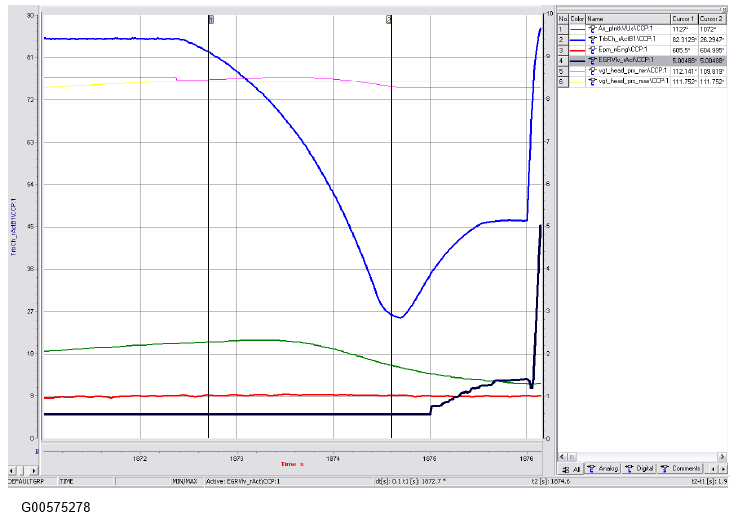
In the example above, at 1871 seconds, the EGR valve is commanded closed, after 3 seconds with EGR off and turbocharger at 85% position, the turbocharger is opened up to. 25% position. The 25% position is held for 4 seconds. If desired separation of 2kpa at sea level is achieved the test is considered a pass. If desired separation isn't achieved the test is completed and failed.
NOTE:
this monitor also serves to monitor for a slowly responding boost pressure system due to the time component of the threshold.
VGT MONITOR
| DTCs |
P132B - Turbocharger/Supercharger Boost Control "A" Performance |
| Monitor Execution |
Once per driving cycle |
| Monitor Sequence |
VGT, then wastegate |
| Sensors OK |
ECT, MAP, VS |
| Typical Monitoring Duration |
7 seconds for full VGT monitoring cycle if pressure abort threshold hasn't been reached |
TYPICAL VGT MONITOR ENTRY CONDITIONS
| Entry Condition |
Minimum |
Maximum |
| Engine speed for learning |
500 rpm |
760 rpm |
| Pedal position allowed for learning |
|
0.5% |
| Engine coolant temperature for learning |
70 deg C |
124 deg C |
| Fuel quantity allowed for learning |
|
20 mg/stoke |
| Vehicle speed for learning |
|
3 mph |
| Loop counts after brake cycle |
|
800 counts |
| Barometric Pressure |
67 kPa |
102 Kpa |
| Time after engine start |
120 seconds |
|
TYPICAL VGT MONITOR MALFUNCTION THRESHOLDS
| Response from 25% VGT position to 85% VGT position in 4 seconds results in a change in manifold pressure of 2 kPa or greater at sea level or 1.25 kPa at 8000 feet. |