September 30: LEMON manuals is back up on a temporary server! Slowness is possible
Clutch Assembly: Inspection
- Clean oil, grease, metal deposits, etc. from flywheel mating surfaces. DO NOT use air pressure to clean clutch parts. Inspect flywheel for cracks, heat marks, warpage or other damage. Replace or repair as necessary.
- Check wear on clutch disc's facing by measuring depth of each rivet head depression. See CLUTCH DISC SERVICE LIMITS
. If depth has reached service limit at any rivet head, replace clutch disc assembly. Check pressure plate for wear or damage. Maximum runout of clutch disc facing is .031" (.79 mm). Replace clutch disc if runout is not within specification.
- If pressure plate is excessively worn or damaged, replace pressure plate assembly. Check pilot bearing for smooth operation. If bearing does not spin freely, replace it.
- Check wear on disc's facing by measuring depth of each rivet head. Minimum depth at any rivet is .012" (.30 mm). Maximum runout of clutch disc facing is .031" (0.8 mm). Replace clutch disc if runout is not within specification.
- Check pressure plate for wear or damage. If pressure plate assembly is excessively worn or damaged, replace pressure plate. Check pilot bearing rotation. If roughness is felt, replace bearing.
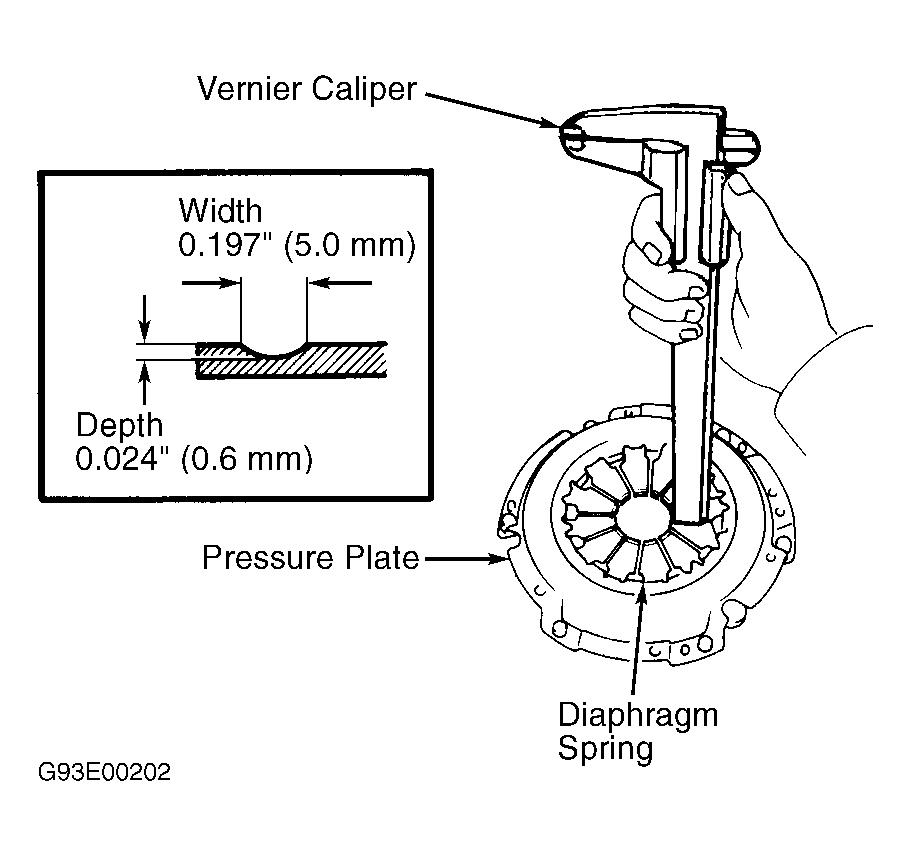
- Using a vernier caliper, measure depth and width of diaphragm spring. If diaphragm spring depth exceeds 0.024" (0.6 mm) or width exceeds 0.197" (5.0 mm), replace pressure plate. See Fig 1
.
 Courtesy of GENERAL MOTORS CORP.
- Lay pressure plate on a flat surface with diaphragm spring up. Place clutch release bearing on diaphragm spring and measure distance from release bearing to all spring fingers. If any diaphragm spring finger is farther than 0.020" (0.5 mm) from clutch release bearing, replace pressure plate.
- Inspect flywheel runout. Maximum flywheel runout is .004" (.10 mm). If runout is excessive, replace flywheel. Clean oil, grease and metal deposits from flywheel and pressure plate. Inspect for damage, cracks or warpage. Slight surface scoring can be removed with sandpaper. Replace or repair as necessary.
- Check wear on disc's facing by measuring depth of each rivet head. Minimum depth at any rivet is .008" (.20 mm). Maximum runout of clutch disc facing is .031" (.80 mm). Replace clutch disc if runout is not within specification.
- Using a vernier caliper, measure depth and width of diaphragm spring. If diaphragm spring depth exceeds 0.024" (0.6 mm) or width exceeds 0.197" (5.0 mm), replace pressure plate. See Figure
.
- Lay pressure plate on a flat surface with diaphragm spring up. Place clutch release bearing on diaphragm spring, and measure distance from release bearing to all spring fingers. If any diaphragm spring finger is farther than 0.020" (0.5 mm) from clutch release bearing, replace pressure plate.
- Check pressure plate for wear or damage. If pressure plate assembly is excessively worn or damaged, replace pressure plate. Check pilot bearing rotation. If roughness is felt, replace bearing. Inspect flywheel runout.
- Maximum flywheel runout is .004" (.10 mm). If runout is excessive, replace flywheel. Clean oil, grease and metal deposits from flywheel and pressure plate. Inspect for damage, cracks or warpage. Slight surface scoring can be removed with sandpaper. Replace or repair as necessary.