September 30: LEMON manuals is back up on a temporary server! Slowness is possible
Ignition Timing
- Set automatic transmission lever to Park position, or manual transmission lever to Neutral position. Disconnect and plug hoses attached to diaphragm on distributor. Connect tachometer and timing light. Turn off all electrical loads.
- Warm engine to operating temperature. Ensure idle speed is set to specification. See IDLE SPEED & MIXTURE. Determine initial timing. See IGNITION TIMING table. If base timing is not correct, loosen distributor mounting bolts. Rotate distributor until marks align. Tighten bolts to 14-18 ft. lbs. (19-25 N.m).
IGNITION TIMING
| Application |
Auto. Trans. |
Man. Trans. |
| Non-Turbo |
1-3 @ 800-900 |
1-3 @ 800-900 |
| Turbo |
11-13 @ 800-900 |
11-13 @ 800-900 |
- Increase engine RPM while observing timing marks. Verify ignition timing advances. See CENTRIFUGAL ADVANCE SPECIFICATIONS table. For turbo models, go to step 5). For non-turbo models, continue with next step.
CENTRIFUGAL ADVANCE SPECIFICATIONS
| Application |
Degrees BTDC |
| Non-Turbo |
| 1500 RPM |
0 |
| 3000 RPM |
21 |
| 5000 RPM |
25 |
| Turbo |
| 1200 RPM |
0 |
| 3500 RPM |
12 |
| 5500 RPM |
18 |
- On non-turbo models, apply 16 in. Hg vacuum to chamber "A". See Fig 1
. Verify timing advances by 26-30 degrees. Remove vacuum source from chamber "A". Apply 8 in. Hg vacuum to chamber "B" while observing timing. Verify timing advances by 3-7 degrees. Stop engine. Remove test equipment.
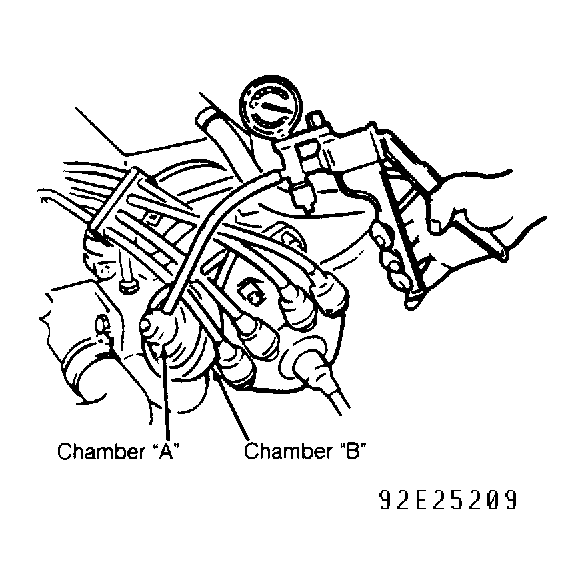 Courtesy of FORD MOTOR CO.
- On turbo models, apply 20 in. Hg vacuum to advance diaphragm. Verify timing advances by 13-17 degrees. Disconnect vacuum source. Apply 8 psi (0.6 kg/cm2
) pressure to advance diaphragm. Verify timing retards by 3-7 degrees. Stop engine. Remove test equipment.