E8B Checking Control Module Output Signals to the Injectors
E8B Checking control module output signals to the injectorsTools:
- Screwdriver or stethoscope
- Multimeter
- Tachometer
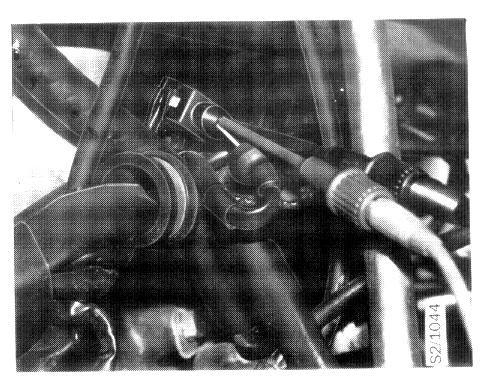
1 Plug in the control module and mass air flow sensor connectors and connect the Hall sensor lead to the distributor (if previously unplugged or disconnected). Connect the tachometer.
2 Pull up the rubber dust excluder over the connector on one of the injectors.
Note: Do not use a test lamp when checking the control module's output signals to the injectors.
3 Connect the multi meter test prods to the injector terminals.
Note: Polarity: Red (+) prod to the blue/red (BL/RD) lead and black (-) test prod-to the green/red (GR/RD) lead.
4 Start the engine and check the voltage reading against the table below.
Engine temperature Voltage
0°C (32°F) 1 V
20°C (68°F) 0.6 V
80°C (176°F) 0.3 V
5 If the engine runs erratically when idling, check during the warm-up period that all injectors are working properly. This can be done by placing a screwdriver or stethoscope against the black metal part of the injector. A clicking sound should be heard if the injector is working.
a If no clicking sound can be heard from one or more injectors, refer to section E6 "Checking the injectors".
b If the injectors can be heard clicking but the engine still runs erratically when idling:
Remove one connector at a time from the injectors. Use a small screwdriver to relieve the tension in the spring clips. This should cause engine revs to drop.
c If engine revs do not drop, make a thorough inspection of the following systems:
- The fuel system
- The induction system
- The electrical system
6 When the engine has reached normal operating temperature, rev it up to 3000 rpm. Measure the voltage across the injector, which should rise to 0.8-0.9 V. Let the engine revert to idling speed and then rev it up rapidly to 3000 rpm again. The voltage should now rise above 0.8-0.9 V momentarily before dropping back to 0.8-0.9 V.