October 30: LEMON manuals on a temporary server, it is slow and having issues, download the manuals you need! Later in November we will switch back to the fast server.
EGR System
 Courtesy of © TOYOTA, LICENSE AGREEMENT TMS1002
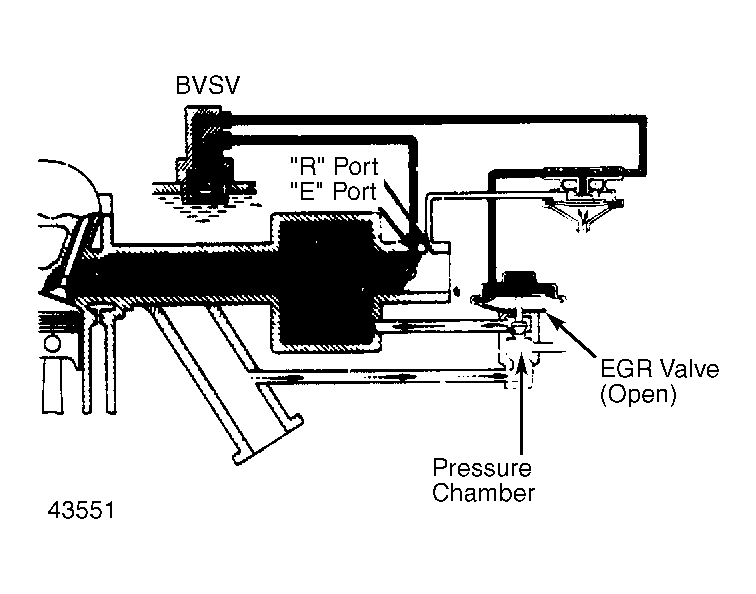
- Check EGR modulator filter for contamination or damage. Using compressed air, clean filter. Using 3-way connector, connect a vacuum gauge to hose between EGR valve and EGR vacuum modulator. See Fig 1.
- Check seating of EGR valve, check that engine starts and runs at idle.
- To check BVSV, coolant temperature should be below 104°F (40°C). Check reading of vacuum gauge, it should be 0.
- With engine at operating temperature, check BVSV and EGR vacuum modulator. Check that vacuum gauge indicates low vacuum at 3500 RPM.
- Disconnect vacuum hose from port R of EGR vacuum modulator and connect port R directly to intake manifold with another hose. Check that vacuum gauge indicates high vacuum at 3500 RPM. See Fig 2.
NOTE:
As a large amount of EGR gas enters, engine will misfire slightly at this time.
- Disconnect vacuum gauge and reconnect vacuum hoses to proper locations.
- To check EGR valve, apply vacuum directly to EGR valve with engine idling. Check that engine runs rough or dies. Connect vacuum hoses to proper location. If a problem is found, inspect each part and either repair unit or replace it.
 Courtesy of © TOYOTA, LICENSE AGREEMENT TMS1002