Cranks Normally But Will Not Start: Notes
CRANKS NORMALLY BUT WILL NOT START (VINs 7, L, M) DESCRIPTION AND POSSIBLE CAUSE
| Troubleshooting item |
Cranks normally but will not start |
| Description |
- Cranking occurs but no ignition.
|
| Possible cause |
NOTE:
- Even though the fuel gauge indicates the presence of sufficient fuel, the fuel is not transferred from the fuel tank (sub) to the fuel tank (main), which may cause fuel shortage and then engine stalling. The body control module (BCM) triggers the low fuel warning light to flash to alert the customer of the risk of engine stalling.
- Low fuel tank level
- PCM reprogramming not implemented
- Because engine is started with accelerator pedal fully depressed, it goes into dechoke mode and fuel is not injected
- Engine overheating
- PCM DTC is stored
- Erratic signal to PCM
- APP sensor or related circuit malfunction
- ECT sensor No. 1 or related circuit malfunction
- ECT sensor No. 2 or related circuit malfunction
- MAF sensor or related circuit malfunction
- A/F sensor or related circuit malfunction
- HO2S or related circuit malfunction
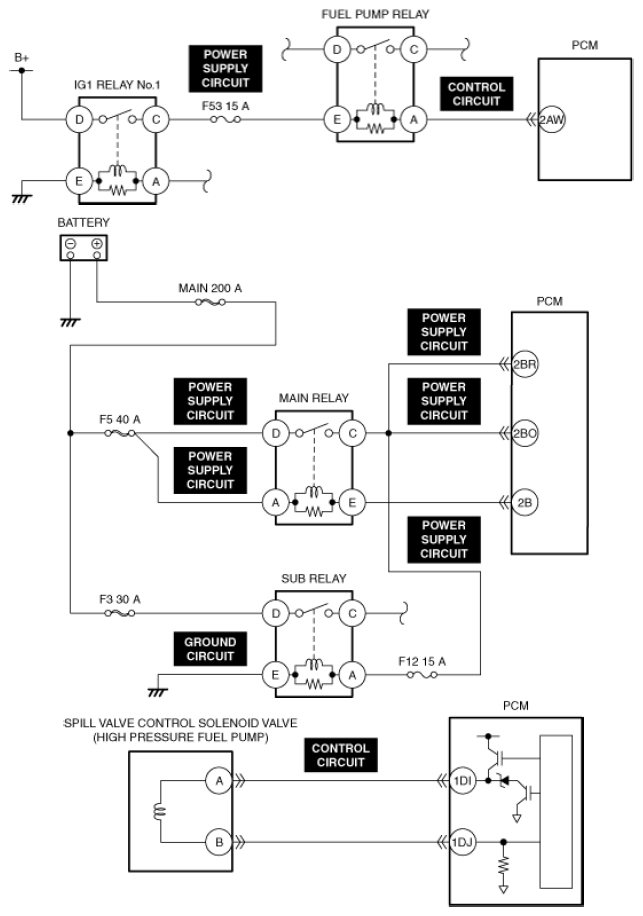
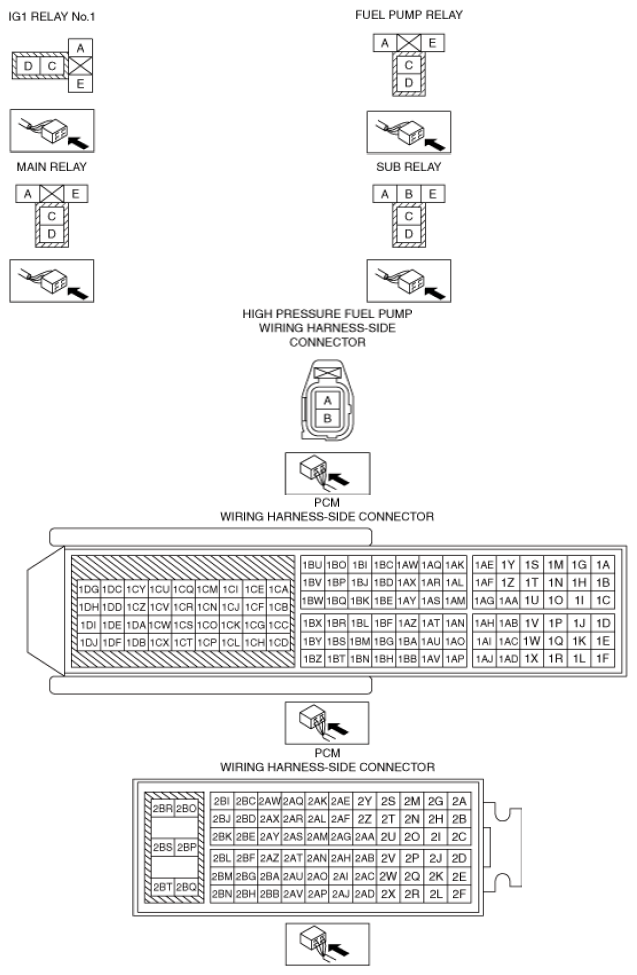
- Power is not supplied from main relay
- Power is not supplied from sub relay and/or fuel pump relay
- Improper operation of drive-by-wire control system
- Purge solenoid valve malfunction
- No signal from MAF sensor
- Poor fuel quality
- Air leakage from intake-air system
- Intake-air system restriction
- Electrical connector disconnected
- No battery power supply to PCM or poor ground
- Fuse malfunction
- Fuel leakage
- Vacuum leakage
- No signal from CKP sensor
- Loose installation
- Damaged trigger wheel (crankshaft pulley)
- Open or short circuit in related wiring harness
- No signal from CMP sensor
- Loose installation
- Damaged trigger wheel (exhaust camshaft)
- Open or short circuit in related wiring harness
- Inadequate fuel pressure (high pressure side)
- Fuel pressure sensor or related circuit malfunction
- High pressure fuel pump malfunction
- Relief valve (built-into high pressure fuel pump) malfunction
- Spill valve control solenoid valve control circuit malfunction (damage to driver in PCM caused by short circuit to ground system)
- Spill valve control solenoid valve malfunction (built-into high pressure fuel pump)
- Low-pressure side fuel delivery system malfunction
- Battery voltage decrease
- Fuel pump unit malfunction
- Fuel filter (high-pressure) clogged (built-into fuel pump unit)
- Fuel filter (low-pressure) clogged (built-into fuel pump unit)
- Pressure regulator (built-into fuel pump unit) malfunction
- Jet pump (built-into fuel pump unit) malfunction
- Clogging in hose between fuel tank (main) and fuel tank (sub)
- Disconnected hose between fuel tank (main) and fuel tank (sub)
- Incorrect fuel injection timing
- Fuel injector malfunction
- Vapor occurs around fuel pump (fuel problem)
- Because vapor occurs in high pressure fuel pump, fuel injector cannot adjust fuel injection to correct amount
- Improper operation of electric variable valve timing control system (PCM DTC is stored.)
- Improper operation of hydraulic variable valve timing control system
- Low engine compression
- Improper intake valve timing
- Improper exhaust valve timing
- Ignition system malfunction
- Ignition coil malfunction
|
| Possible cause |
- Exhaust system and/or TWC restricted
- PCV valve malfunction
- Injector driver (built-into PCM) malfunction
WARNING:
- The following troubleshooting flow chart contains the fuel system diagnosis and repair procedures. Read the following warnings before performing the fuel system services:
- Fuel vapor is hazardous. It can easily ignite, causing serious injury and damage. Always keep sparks and flames away from fuel.
- Highly pressurized fuel may spray out if the fuel line is cut. Due to the following dangers occurring with a fuel spray, always complete the "Fuel Line Safety Procedure" to prevent the fuel from spraying. (See BEFORE SERVICE PRECAUTION [(VIN M)]
.) (See BEFORE SERVICE PRECAUTION [(VIN 7 & VIN L)]
.)
- Fuel may cause irritation if it comes in contact with skin and eyes.
- If fuel ignites and causes a fire, it may lead to serious injury or death, and damage to property and facilities.
CAUTION:
- Disconnecting/connecting the quick release connector without cleaning it may possibly cause damage to the fuel pipe and quick release connector. Always clean the quick release connector joint area before disconnecting/connecting, and make sure that it is free of foreign material.
|
 Courtesy of MAZDA MOTORS CORP. Courtesy of MAZDA MOTORS CORP.
|
 Courtesy of MAZDA MOTORS CORP. Courtesy of MAZDA MOTORS CORP.
|
CAUTION:
- Verify the malfunction symptom according to not only the PID value but also the symptom troubleshooting.