Diagnosis & Repair
- Access ECM behind glove box. Remove intake air duct and disconnect sub-throttle valve step motor connector. Connect Check Harness "A" (SST 09990-01000) to ECM. See TEST PREPARATION under SELF-DIAGNOSTIC SYSTEM. Turn ignition on. Measure voltage between terminals No. 42 and 65 at Check Harness "B" connector. Voltage should be .3-.8 volts with throttle fully closed, and 3.2-4.9 volts with throttle fully open (WOT).
- Measure voltage between terminals No. 63 and 65 at Check Harness "B" connector. Voltage should be 0-3.0 volts with throttle fully closed, and 9-14 volts with throttle fully open (WOT).
- Voltage measurements taken in steps 1) and 2) should increase steadily in proportion to throttle valve opening angle. If voltage measured is as specified, check wiring harness connectors. Problem may be intermittent. If voltage is not as specified, go to next step.
- Remove throttle body. See N - REMOVAL/INSTALL/OVERHAUL article. Disconnect sub-TP sensor connector. Using ohmmeter, measure resistance between terminals VTA2 and E2 at sub-TP sensor. See Fig 1. Resistance should be .3-6.3 k/ohms with throttle fully closed, and 2.4-11.2 k/ohms with throttle fully open (WOT).
- Measure resistance between terminals IDL2 and E2 at sub-TP sensor. Resistance should be less than .5 k/ohms with throttle fully closed, and infinite resistance with throttle fully open (WOT).
- Resistance measurements taken in steps 4) and 5) should increase steadily in proportion to throttle valve opening angle. If resistance measured is as specified, go to next step. If resistance is not as specified, check sub-TP sensor adjustment. See ADJUSTMENTS
article. Adjust as necessary. If adjustment is okay, replace sub-TP sensor.
- Inspect circuits between sub-TP sensor and ECM for opens or shorts. See appropriate wiring diagram in WIRING DIAGRAMS
article. Repair as necessary. If circuits are okay, replace ECM and retest.
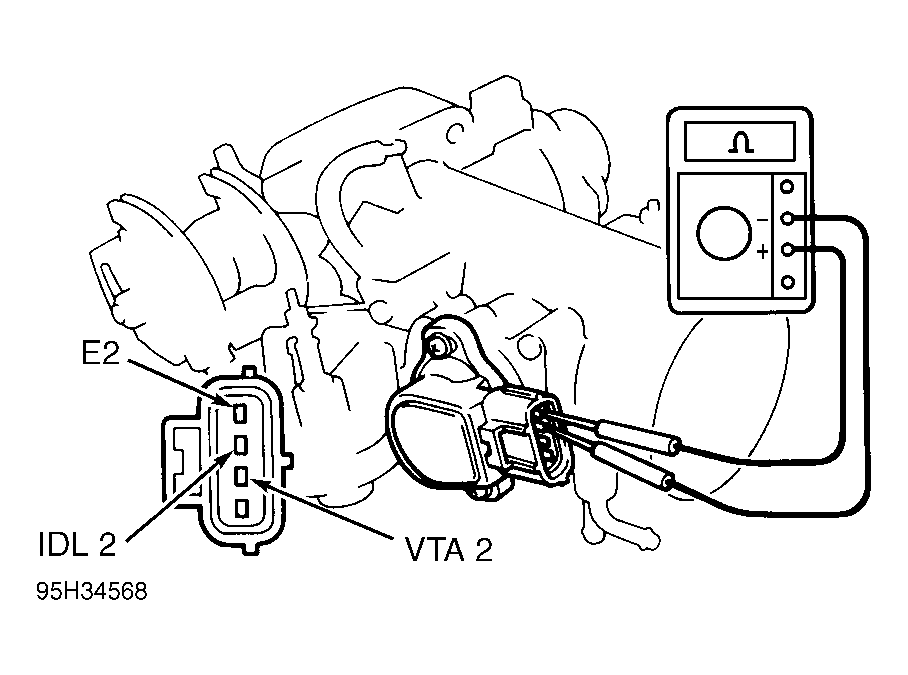 Courtesy of © TOYOTA, LICENSE AGREEMENT TMS1002